Karakter boyutu :


Estonya Devlet Başkanı İlves’in Birleşmiş Milletler Uluslararası Yerli Halklar Konferansında Yaptığı Konuşma

06 Ekim 2014 Pazartesi Saat 17:33
22 Eylül 2014
Bayanlar ve Baylar,
Yerli halkların hakları için düzenlenen bu üst düzey toplantıda konuşma yapmaktan onur duyuyorum. Yerli bir halkın mensubu olarak –Estonyalılar bugünkü toprakları üzerinde binlerce yıldır yaşıyorlar- aranızda çok sayıda yerli halkın üyelerini görmek beni özellikle memnun ediyor. Bu sayede yerli halkları ilgilendiren konuları birlikte tartışabiliriz. Estonyalılar baskı görmüş yerli halk olarak ve şimdi Birleşmiş Milletler üyesi sıfatıyla her iki tarafta da bulundular. Yerli halkların sorunlarını biliyoruz. Yerli halkların BM etkinliklerine katılımının sürekli engellenmesinin bir talihsizlik olduğunu konuşmamın başında vurgulamak istiyorum. Bazı devletlerin açıklama yapmadan uyguladığı yasaklar tuhaf ve utanç verici denilmese bile anlaşılmazdır. Bu durumun en kısa sürede sona ermesini ve yerli halkların uluslararası topluluk içinde güçlü bir sese sahip olmalarını umuyoruz.
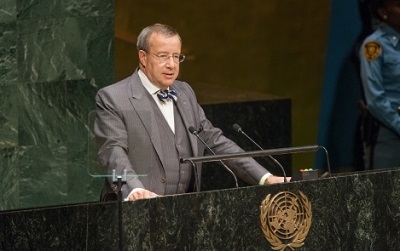
Bugün kabul edeceğimiz nihai belgenin içeriğinin müzakere edilme sürecinin son aşamalarına katılamamıştınız. Bununla birlikte erken aşamalarda sunduğunuz katkı belgeye hep birlikte sahip çıkmamızı mümkün kılıyor.
Nihai belgede Birleşmiş Milletler Yerli Halklar Halkları Deklarasyonu (UNDRIP) ilkelerinin teyit edilmesinden dolayı memnunum. Belge BM’nin rolünün güçlenmesi de dahil olmak üzere yerli halkların haklarının iyileştirilmesini öngörüyor. Nihai belgenin ileride yol haritası işlevi göreceğini ve hemen uygulanacağını umuyorum.
Bayanlar ve Baylar,
Yerli halkların haklarına saygı duyulmalıdır. Devletlerin büyük çoğunluğu Yerli Halklar Hakları Deklarasyonuna destek veriyorlar. Estonya da öyle. Ama ne yazık ki birçok ülkede maddi kazanımlar temel hakların üzerinde tutuluyor. Yerli halkların kültür mirasının bir zenginlik olduğunu anlamalıyız. Bu zenginlik yerli halkların doğal kaynaklarının yağmalanmasından elde edilen kardan daha önemlidir Halkların kültürleri pahasına kar edilmesine birçok Fin-Ugor bölgesinde tanık olduk.
Estonyalılar soy ve dil bağıyla akraba oldukları Fin-Ugor halklarının geleceğiyle yakından ilgileniyorlar. Yok olma korkusunu yaşadık ve yaşamaya devam ediyoruz. Sayılarının azalmasını endişeyle izledik. Sosyo-politik aktivizm sorunlarını çözmeye yetmedi. Bizce en kötü senaryo ulusal örgütlerinin dağılması, liderlerinin tasfiye edilmesi ve yaşadıkları ülkelerin onlara karşı kayıtsız davranmasıdır. Yani Sovyet döneminden aşina olduğunuz ifadeyle yerli halkların “perspektifleri olmadığının” iddia edilmesidir.
Kentleşme, sanayileşme, dünya savaşları, sürgünler ve kitlesel göçler pek çok yerli halkta derin yaralar açtı. Bunlar arasında Fin-Ugor kuzenlerimiz Vot halkı var. 1990’lı yılların sonunda büyük bir proje olan Laugasuu (Ust-Luga) limanı inşaatı başladı. Liman geleneksel Vot toprakları üzerinde inşa ediliyor. Kuzenlerimizin bu topraklar üzerindeki tarihi biz Estonyalıların kendi topraklarımız üzerindeki tarihimiz kadar eski. Liman projesi kalan üç Vot köyünü tehdit ediyor. Bu köylerin adları Luutsa, Liivtšülä ve Jõgõperä. Laugasuu liman inşaatı BM Yerli Halklar Hakları Deklarasyonuyla çelişiyor. Ama Votlar bu durumdaki tek halk değil. Çok sayıda yerli halkın çetin koşullar altında yaşamaya çalıştığını biliyoruz. Mesela Vot halkıyla yan yana yaşayan bir başka Fin-Ugor kökenli küçük ulus olan İzhorlar. Bu halkın yaşadığı Rutši ve Viistina köylerinin yanına kimyevi maddeler üreten bir fabrika kurulmak isteniyor. Fabrika kurulursa çevre tahribatı bu ulusu ve kültürü yok edecek. Dünya biraz daha yoksullaşacak.
Estonya hükümeti yerli Ural dillerini ve kültürlerini desteklemek için 1999 yılında Akraba Halklar Programı’nı başlattı. Beş alanda destek sunuluyor : eğitici kurslar ; araştırma ; kültür ve bilgi değişimi ; sağlık hizmetleri ; çevre koruma. Estonyalı uzmanlar uzun yıllar boyunca BM Yerli Konular Kalıcı Forumu’na katkı sundular. Hükümetimiz BM Yerli Halklar Fonu’nu mali açıdan destekledi. Katkımız ve desteğimiz gelecekte de devam edecek.
Bayanlar ve Baylar,
Maori halklarını her zaman heyetlerine ve toplantılara dahil ettiği için Yeni Zelanda’nın adını zikretmek istiyorum. BM’deki tüm yerli halklar toplantılarına Sami temsilci heyetinin katılımını garantiledikleri ve yerli halkların geleceği için samimi kaygılarını dile getirdikleri için Finlandiya, Norveç ve İsveç’e teşekkür ediyorum. Koola Sami halkının toplantıya katılmasının engellenmesiyle ilgili olarak Finlandiya Devlet Başkanı’nın görüşlerini paylaşıyorum. BM Yerli Halklar Hakları Deklarasyonu’nu desteklediği ve Kırım Tatarları’nı yerli halk olarak tanıdığı için Ukrayna’ya şükranlarımı sunuyorum.Yerli halkların yaşam koşullarını iyileştirmek için adım atan diğer ülkelere de teşekkür etmek istiyorum.
Yerli halkları desteklemek için elimizden geleni yapmalıyız. Geçmişlerine saygı duymalı, geleceklerini sunmalıyız. Yerli halklar nerede yaşarlarsa yaşasınlar – Leningrad Oblastı, Kırım, Amazonlar, Yeni Zelanda, Arizona veya İskandinav yarımadası- bilinmeliler. Çok uzun süre suskunluğuna mahkum edilen bu seslere kulak vermeyi öğrenelim. Yerli halklara karşı işlenen suçları örten ve yerli halkların kendi gelecekleri üzerine söz sahibi olma hakkını inkar eden sömürgeci zihniyetin sürmesine izin veremeyiz.
Eski Estonya Devlet Başkanı, yazar ve sinemacı Lennart Meri bu halkları dinledi ve onları filme aldı.Sizi akşam altıda Konferans binasında Meri’nin sinema yolculuğunu konu alan fotoğraf sergisini ziyaret etmeye davet ediyorum.Sergi yerli halkların kaderiyle yakından ilgilenen bu büyük sinemacıya saygı amacıyla düzenlenmiştir.
Kaynak: http://www.president.ee/en/official-duties/speeches/10587-president-ilves-at-the-united-nations-world-conference-on-indigenous-peoples-22-september-2014/index.html
Çeviri : Dr. Ömer Aytek Kurmel
Cherkessia.net, 6 Ekim 2014
****
President Ilves at the United Nations World Conference on Indigenous Peoples
22 September 2014
Ladies and Gentlemen,
It is an honour to address this high-level meeting dedicated to the rights of indigenous peoples. As a member of an indigenous people – Estonians have lived on our present territory for several thousand years – I am especially happy to see among you so many about whom this conference is concerned. Thus we can discuss issues faced by indigenous people together. We have stood on both sides, as an oppressed indigenous people and now as a member of the United Nations. We know what indigenous peoples face. I would like also to flag at the very outset that it is unfortunate that the participation of indigenous peoples in UN fora is constantly questioned. It is incomprehensible, if not to say bizarre and shameful that some states attempt to hinder the participation of indigenous peoples, offering no explanation of their actions. We hope that this will soon be the past and that indigenous peoples will have a strong voice in the international community.
I recall that you, the indigenous peoples, the ones most directly affected by the provisions of the outcome document we are to adopt today, could not participate in the negotiations about it at the very last stages. However, I believe that your input in the earlier stages provided a good basis for joint ownership of this document.
I am pleased that in the outcome document today we reaffirm our commitment to the United Nations Declaration on the Rights of Indigenous Peoples (UNDRIP). It includes clear deliverables to further improve indigenous peoples' rights, including stronger action by the UN. I hope that the outcome document will serve as a basis for the way ahead and we are looking forward to its swift implementation.
Ladies and Gentlemen,
The rights of indigenous peoples must be respected. The great majority of states do so, voicing their support for the Declaration on the Rights of Indigenous Peoples. So too has Estonia. Unfortunately, however, in many countries, material gains are often prioritized over fundamental rights. It is crucial to understand that the cultural heritage of indigenous peoples is a form of wealth that clearly outweighs the economic profit gained by extensive and unsustainable exploitation of natural resources. This reckless pursuit of profit at the expense of peoples' culture is precisely what we have witnessed in many Finno-Ugric areas.
For Estonians, the future of Finno-Ugric peoples with whom we are linked in kinship and language is particularly close to our hearts. We know and have felt the fear of extinction. We have observed with concern that their populations have decreased, while socio-political activism to improve to their position has not always corresponded to this major challenge. The worst scenario, in our view, would be that national organizations vanish, leaders marginalized and the countries where they live indifferent – claiming that indigenous peoples as such have, to quote a phrase we know from the soviet era, "no perspective".
Urbanization, industrialization, world wars, deportations and extensive migration all have left deep wounds within many indigenous populations. Including, for example, the Votic population, our Finno-Ugric cousins. A few years before the turn of the millennium the construction of the large Laugasuu (Ust-Luga) port began. It is being built on traditional Votic lands where our cousins have lived for as long on their territory as we Estonians on ours. This construction poses a great danger to the last three remaining Votic villages: Luutsa, Liivtšülä and Jõgõperä. Even though the construction of Laugasuu port is in conflict with the UN Declaration on the Rights of Indigenous Peoples, the current situation faced by the Votes is hardly unique. We all know there is a long list of indigenous peoples living in the most challenging of conditions. For example, side by side with the Votes lives another small Finno-Ugric nation, the Izhorians, who are especially endangered by the plan to erect a chemical plant right next to their villages of Rutši and Viistina. If the chemical plant is be erected and the environment destroyed, the nation and culture would be endangered and might be even destroyed. And mankind will grow ever poorer.
To support our kindred-nations, the Estonian Government launched the Kindred Peoples Programme in 1999. It is a government aid programme for supporting indigenous Uralic languages and cultures. It provides support in five different fields – education and training courses, research, culture and information exchange, as well as healthcare and protection of the environment. For years Estonian experts have contributed to the UN Permanent Forum on Indigenous Issues and our government has provided financial support to the UN Fund on Indigenous Populations. We shall continue to do so in the future.
Ladies and Gentlemen,
I would like to acknowledge New Zealand for always including Maori peoples in their delegation and meetings. I'd like to thank Finland, Norway and Sweden for guaranteeing a representative Sami delegation to all of the indigenous peoples' meetings at the UN and for voicing their sincere concern about the future of indigenous peoples. I'd like to associate myself with the Finnish President's remarks about Koola Sami people being prevented from attending the meeting. I'd like to thank Ukraine for supporting the UNDRIP and recognising the Crimean Tatars as an indigenous peoples; I'd like to thank many other countries who are taking steps to improve the situation of indigenous peoples.
We are obliged to do everything we can to support indigenous peoples; to respect their past and to grant them their future. Indigenous peoples, no matter if they live in the Leningrad Oblast, Crimea, the Amazonas, New Zealand, Arizona or the Scandinavian peninsula, they must all be fully acknowledged. Let us learn to listen to the voices that have been silenced for too long and too often continue to be. We cannot allow persistence of colonialist mentality to cover-up crimes committed against indigenous peoples, to continue to deny indigenous peoples the right to have a say over their own futures.
To finish, the former Estonian president, the beloved writer and filmmaker Lennart Meri, was one of those individuals who dared to listen to these peoples and to film them. I would like to invite you to the opening of an exhibition of photos of his film journeys in the Conference building today at 6 p.m. It is a tribute to the great filmmaker deeply who cared about the faith of indigenous people.
Bu haber toplam 2590 defa okundu.


GENÇ WERTHER
Erdal abilerim BM salonunda konuşması havai fişekler eşliğinde dinlense ne olacak allahaşkınıza? Dünyada milletler birbirine girmek için fırsat kolluyor baksana.
Dinleyip alkışlıyorlar sonrada yapacaklarını yapıyorlar.
Worginoqo Erdal (Şawazuk)
Gerçekten çok etkileyici konuşma estonya devlet başkanı İlves'in konuşması.
Bir alt çevirinizde ki Estonyalı prof. Martin Ehala'nın görüşleri ile beraber yayınlamanız estonlarla aramızda ki empati noktalarını hatırlattı. Yayın çizginiz ustaca.
Teşekkürler.
Not:Benzer toplantılarda çerkes halkının temsilcileride olmalı. Neredesiniz ey caka satan çerkes temsilcileri??????????????????????????????????????????????
Şewoj Erdal
Çok güzel bir konuşma !!!!
09 Ekim 2014 Perşembe Saat 08:33