Karakter boyutu :


Valery Dzutsev : Moskova için Bölgelerin Denetimini Elde Tutmak Ekonomik Kalkınmalarından Daha Öncelikli

04 Mayıs 2015 Pazartesi Saat 21:45
Valery Dzutsev, 29 Nisan 2015
Rus hükümeti Hazar Denizi’ni Azak Denizi ve Karadeniz üzerinden okyanusa bağlamak için kanal açmayı düşünüyor. Yeni rotanın Çin mallarını Orta Asya yoluyla Avrupa’ya taşıyacak en kısa ve en ekonomik yol güzergaholacağı söyleniyor. Petrol ve gazı Hazar Denizi yoluyla dış pazarlara taşıyan boru hatlarının kapasitesi artık yetmiyor. Proje bu soruna çözüm bulma iddiasında. Yeni nakil projesinden başta Kazakistan olmak üzere Orta Asya ülkeleri kazançlı çıkacak. Yeni bağlantı Kuzey Kafkasya’nın durgun ekonomilerini de canlandıracak. İstihdam yaratacak, dünya piyasalarına erişim sağlayacak ve yabancı sermaye çekecek. Avrasya Kalkınma Bankası ön değerlendirme için 2.7 milyon milyon dolar ayırdı. Araştırmanın sonuçları Rusya Ulaştırma Bakanlığı’nın kapalı oturumunda ele alındı (Kavkazskaya Politika, 17 Nisan).
“Avrasya kanalı” olarak adlandırılan söz konusu proje Kuzey Kafkasya ve genel olarak güney Rusya’da çok ciddi bir ekonomik ve siyasal etki yapacak (bkz EDM, 25 Haziran 2007). Güney Rusya’nın büyük tarım potansiyeli Çinli yatırımcıların ilgisini çekiyor. Kuzey Kafkasya’ya Çin yatırımları bölge ekonomisinicanlandıracak ve Moskova’nın sübvansiyonuna bağımlılığı azaltacak. Rus hükümeti prensip olarak kalkınmayı denetimi altında tutuyor. En verimli kalkınma projeleri bile Rus hükümetine Kuzey Kafkasya üzerindeki denetiminin tehlikeye girmeyeceği güvencesi vermedikçe yoluna devam edemiyor.
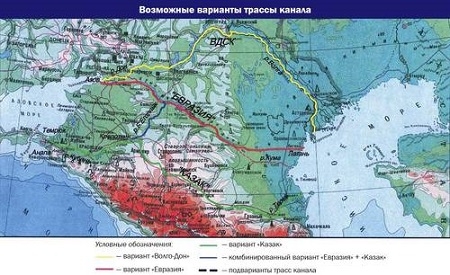
Önerilen “Avrasya kanalı” (kırmızı) ve mevcut Volga-Don kanalı (sarı) (Kaynak : worldenergy.ru)
Kanalı Terek, Kuma ve Kuban nehirleri üzerinden inşa etmek için 17 milyar dolardan fazla bir bütçe gerekiyor. Bu, Rusya ve Kazakistan’ın telaffuz edemeyeceği bir rakam. 740 kilometre uzunluğundaki yeni kanal,1.074 kilometrelik mevcut Volga-Don kanalından bir buçuk defa daha kısa olacak.
Volga-Don kanalının yıllık akımı 16.5 milyon ton iken yeni kanalın yıllık kapasitesi 75 milyon ton olacak. Volga-Don kanalının 5.000 ton veya altı gemilerle sınırlı kapasitesine karşılık Avrasya kanalının üst limiti 10.000 ton olacak. Daha ılıman iklim koşulları nedeniyle Avrasya kanalı yılın 10-11 ayında faal olacak. Volga-Don kanalı ise yılda 7-9 ay açık (Kavkazskaya Politika, 17 Nisan). Hazar ve Karadeniz’i bağlamak için birkaç seçenek var. Avrasya kanalı en pahalı seçenek. Volga-Don kanalı uzantısı ise değerlendirilen alternatifler içinde en ekonomik olanı (Rzd-partner.ru, 21 Kasım 2007).
Hazar-Karadeniz kanal inşaatıyla en çok Rusya ve Kazakistan ilgileniyor. İki ülkenin 2015 sonuna kadar son kararlarını vermeleri bekleniyor. Kazakistan’ın Avrasya kanalıyla ilgilenmesinin sebebi Hazar ile Karadeniz arasında en kısa ve en hızlı bağlantı olması. Rusya’nın ilgisinin nedenleri bu kadar net değil. Bazı gözlemciler Rusya’nın Kazakistan üzerindeki etkisinin artacağını söylüyorlar ama ayrıntıya girmiyorlar. Hazar Denizi’nde petrol üretiminin beklenen artışı Kazakistan’ı alternatif rotalar aramaya sevk ediyor. Rusya ise Orta Asya petrolünün küresel piyasalara ulaşmasını istemiyor. Kazakistan ve Rusya’nın kanaldan farklı beklentileri var (Odnako, 23 Nisan).
Moskova’nın Kuzey Kafkasya’yı ilgilendiren bölgesel ulaştırma planları da var. En iddialı proje Kuzey Kafkasya cumhuriyetlerinin Kafkas sıradağları boyunca uzanacak bir karayolu ile Karadeniz’e bağlanmaları öngörülüyor. Vladikafkas’tan başlayarak Nalçik, Kislovodsk, Karaçayevsk, Maykop üzerinden Karadeniz kıyısındaki sayfiye kentleri Gelencik ve Anapa’da bitecek rotanın 800 kilometre olacağı tahmin ediliyor. Karayolunun turizmicanlandırması ve ekonomiyi düze çıkarması bekleniyor. Ne var ki ekonomik durgunluk ve dağlık arazi hükümetin planlarını zora sokuyor (Kavkazskaya Politika, 17 Nisan).
Moskova 2014 Kış Olimpiyatı’nda Soçi’nin Kuzey Kafkasya ile bağlarını koparmaya çalıştı. Oysa Soçi coğrafi olarak Kuzey Kafkasya’ya ait. Rusya kenti “güneydeki başkent“ olarak görüyor ve Kuzey Kafkasyalıları sokmamaya çalışıyor. Moskova bir yandan Rusya’dan kopmamaları için Kuzey Kafkasya cumhuriyetlerine para akıtırken diğer yandan ülkeyle bütünleşmelerini bilinçli olarak engelliyor. Ulaşım projesindesiyasal kaygıların ekonomik gereksinimlere ağır bastığı görülüyor.
Çeviri : Dr. Ömer Aytek Kurmel
Cherkessia.net, 4 Mayıs 2015
*****
Moscow Likely to Choose Control of Territories Over Their Economic Development
Valery Dzutsev, April 29, 2015
The Russian government is considering building a new water link connecting the Caspian Sea to the ocean via the Azov and Black seas. The new route is supposed to be the shortest and the cheapest way to carry Chinese goods via Central Asia to Europe. Existing oil and gas pipelines from the Caspian Sea to outside markets also have hit the limits of their capacities, and finding new ways for exporting oil and gas is another important aspect of the project. Central Asian countries are regarded as the primary beneficiaries of the new transportation link, with Kazakhstan reportedly being its most ardent supporter. It is believed the new link will also boost the stagnant economies of the North Caucasus, creating new jobs and providing better access to world markets and investment. The Eurasian Development Bank has allotted $2.7 million for early project assessment, and the results of the research was discussed in the Russian Ministry of Transportation, but that discussion was closed to the public (Kavkazskaya Politika, April 17).
The proposed water link, commonly referred to as the “Eurasia canal,” would significantly affect the economic and political situation in the North Caucasus and southern Russia more generally (see EDM, June 25, 2007). Southern Russia has significant agricultural potential and would certainly be of interest to Chinese investors. Access by Chinese investors to the North Caucasus would also substantially improve local economies and decrease their dependence on subsidies from Moscow. As a rule, the Russian government prefers control to development. Unless the government is reassured that there is no threat to its control over the North Caucasus, it is unlikely to proceed with even the most lucrative developmental projects.
Building the canal via the Terek, Kuma and Kuban rivers would reportedly require over $17 billion, which is probably insurmountable for Russia and Kazakhstan in their current economic situation. The new 740-kilometer-long canal would be nearly one and a half times shorter than the existing Volga-Don canal route, which is 1,074 kilometers long. The throughput of the new canal would be 75 million tons per year, compared to 16.5 million tons via the Volga-Don canal. The Volga-Don canal is restricted to ships that weigh 5,000 tons or less, while the Eurasia canal would have a 10,000-ton limit. Due to the warmer climate, the Eurasia canal would be operational 10–11 months per year, as compared to 7–9 months for the Volga-Don canal waterway (Kavkazskaya Politika, April 17). Several ways of connecting the Caspian and Black seas have been explored. The Eurasia canal appears to be the most expensive, while building an extension to the Volga-Don canal is the least expensive of the options under consideration (Rzd-partner.ru, November 21, 2007).
Russia and Kazakhstan are the two primary parties interested in new water routes between the Caspian and Black seas. The two countries are expected to finalize their decision by the end of 2015. Kazakhstan appears to be interested in the Eurasia canal, which would provide the shortest and the quickest route from the Caspian to the Black Sea. Russia’s interest, however, is more obscure, as some experts talk about increasing Russian influence in Kazakhstan, but do not spell out what that means. The expected increase in oil extraction from the Caspian Sea is forcing Kazakhstan to look for alternative delivery routes to European and world markets. The Russian interest, however, appears to be to keep Central Asian oil from reaching global markets. Thus, Kazakhstan and Russia do not appear to share the same interest in the new water link (Odnako, April 23).
Moscow also has regional transportation development plans for the North Caucasus. The most ambitious is to connect the central North Caucasian republics to the Black Sea via a direct highway that runs alongside the Main Caucasus Ridge. The new route would start in Vladikavkaz and run through Nalchik, Kislovodsk, Karachaevsk, Maikop and on to the resort cities on the Black Sea—Gelendzhik and Anapa. The overall length of the highway is estimated at over 800 kilometers. The highway is expected to boost tourism and improve the overall economic situation in the area. However, economic stagnation and the mountainous terrain, which increases the costs of construction, have allegedly stalled government plans (Kavkazskaya Politika, April 17).
There may not be a sound economic foundation for these plans either, since it is unclear how this highway would benefit the North Caucasian republics or the Black Sea resorts. During the February 2014 Sochi Olympics, Moscow tried to do everything in its power to separate Sochi from the North Caucasus, although Sochi is part of the region geographically. The decision to keep the North Caucasians away from what is seen by many in Russia as the “southern capital” of the country is unlikely to change. Paradoxically, while investing substantial resources into keeping the North Caucasian republics from breaking away from Russia, Moscow at the same time consciously stalled the integration of these republics into the country. In announcing grandiose plans for developing transportation, political considerations appear to trump economic needs in Moscow’s strategic calculus for this ambitious project.
Bu haber toplam 2733 defa okundu.


Bu habere yorum eklenmemiştir. İlk yorumu siz ekleyin.